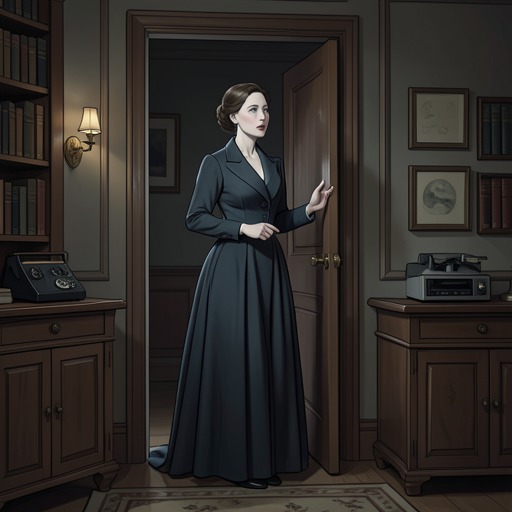
Mrs Tuckerton's involvement in Thomasina's death
The Pale HorseMrs Tuckerton’s suspected involvement in Thomasina Ann Tuckerton’s death grows from a stark inheritance arrangement and a moment of unmistakable panic. Mark Easterbrook can imagine how financial resentment might have drawn her to The Pale Horse and C.R. Bradley, but he does not witness any agreement or discover precisely what happened. The distinction between a compelling motive and a proved transaction is central: the case makes Mrs Tuckerton plausible as a client without closing the gap between suspicion and knowledge.
The inheritance at stake
The will gives Mark a reason to examine Mrs Tuckerton’s position. After bequests to old servants and two godchildren, Thomas Tuckerton provided his wife with an income for life from a sum held in trust. The larger prize—the six-figure residue of the estate—was left to his daughter, Thomasina Ann Tuckerton, absolutely when she reached twenty-one or married. If she died unmarried before twenty-one, that money would pass to her stepmother. The terms set out both a potential financial benefit and the condition on which it depended.
Mark reads the arrangement against what he takes to be Mrs Tuckerton’s appetite for money. In his view, her provision might have seemed modest beside the wealth she had imagined enjoying as a young widow, while Thomasina stood to inherit the fortune outright. He further pictures a household tension sharpened by the stepdaughter’s apparent dislike of her stepmother. These are Mark’s interpretations, not independent proof of Mrs Tuckerton’s feelings or actions; the will establishes the possible incentive, while his account of resentment supplies a hypothesis about its force.
The inheritance also gives the suspicion a precise limit. Mrs Tuckerton would receive the residue if Thomasina died before twenty-one and unmarried, but the evidence does not establish that she arranged a death, or that Mark knows the exact circumstances of any supposed arrangement. The terms make the question urgent without answering it. Wealth is available only through a condition, and the narrative’s suspicion turns on whether that conditional benefit could have become a motive for murder.
Panic and suspicion
After showing Mark her house, Mrs Tuckerton is asked whether she knows The Pale Horse. Her reaction is immediate: panic appears in her pale eyes, and beneath her makeup her face turns white and afraid. She denies knowing anything about it. The abrupt change in her manner makes the question feel like a blow to a concealed vulnerability, and Mark treats it as confirmation that his suspicion has acquired substance.
But her fear does not, by itself, establish what she knows. It is a reaction to the name, not a confession, and the denial leaves open several questions: whether she had approached C.R. Bradley, whether she had committed herself to anything, and whether she had any part in Thomasina’s death. Mark’s response is correspondingly divided. He can construct a motive and read her expression as significant, yet he has difficulty believing that the woman before him could seek out The Pale Horse to have a young girl killed. The scene therefore advances the inquiry through a revealing contrast: the apparent force of her reaction intensifies suspicion, while Mark’s disbelief preserves uncertainty.
Mark’s reconstruction of a possible deal
Mark imagines Mrs Tuckerton travelling to Birmingham and entering C.R. Bradley’s office in the Municipal Square Buildings. In this reconstruction, Bradley reassures a nervous prospective client that the arrangement carries little risk. Mrs Tuckerton may leave without committing herself, Mark supposes, allowing the idea time to take root. He then imagines a later visit or a weekend encounter with her stepdaughter, with talk or hints of marriage bringing the prospective inheritance back into view. The young woman’s manner and friends, as Mark pictures them, become part of the stepmother’s imagined resentment, but remain elements of his reconstruction rather than established events.
He pictures a second visit to Birmingham, more reassurance, and finally a discussion of terms. Mark even imagines Mrs Tuckerton as a hard bargainer who would not let C.R. Bradley have everything his own way, before supposing that terms were agreed and a document signed. Yet he explicitly reaches the boundary of what he knows: he cannot say what followed, or supply the missing step between a possible agreement and Thomasina’s death. The sequence has the shape of a transaction, but its crucial particulars—whether the visits occurred, what was agreed, and how the death was brought about—are not demonstrated in this evidence.
The machinery behind the suspicion
Mark’s later account of The Pale Horse helps explain how such a suspicion could fit into a wider criminal arrangement. C.R. Bradley handles its financial and legal side from Birmingham: a prospective client makes a bet with him on whether a person will die within a stated period. Bradley, fond of wagering, generally predicts death; the client is generally more hopeful. The bet gives the arrangement a financial form, while a client who fails to pay after losing may face an unpleasant consequence. The client then visits The Pale Horse, where Thyrza Grey and her associates stage a performance intended to impress.
Behind the performance, the scheme depends on ordinary access and divided knowledge. Women employed by consumer-research concerns canvass a neighbourhood with questionnaires about routine household choices, including bread, cosmetics, and medicines. Their work provides information about products a potential victim uses; Mark suspects that the women are genuine employees, not necessarily knowing participants in the crime. At a later stage, the organizer personally substitutes a preparation for a similar household product, posing as someone with a plausible reason to enter, such as a meter reader, plumber, electrician, or porter. The victim may become ill only after several days, and a doctor may have little reason to suspect a familiar proprietary product.
This division of roles helps explain both the organization’s reach and the limits of what can be inferred about an individual client. C.R. Bradley arranges the betting and legal-financial business; Thyrza Grey leads the visible ritual; the research questionnaires supply information; and the organizer carries out the substitution. Mark stresses that no one else knows what the head of the organization does. That structure makes a client’s supposed approach to The Pale Horse credible as one stage in a larger operation, but it does not independently establish that Mrs Tuckerton took that stage. Her inheritance, her panic at the name, and Mark’s imagined meetings with C.R. Bradley make a persuasive chain of suspicion—not a complete account of her involvement.